

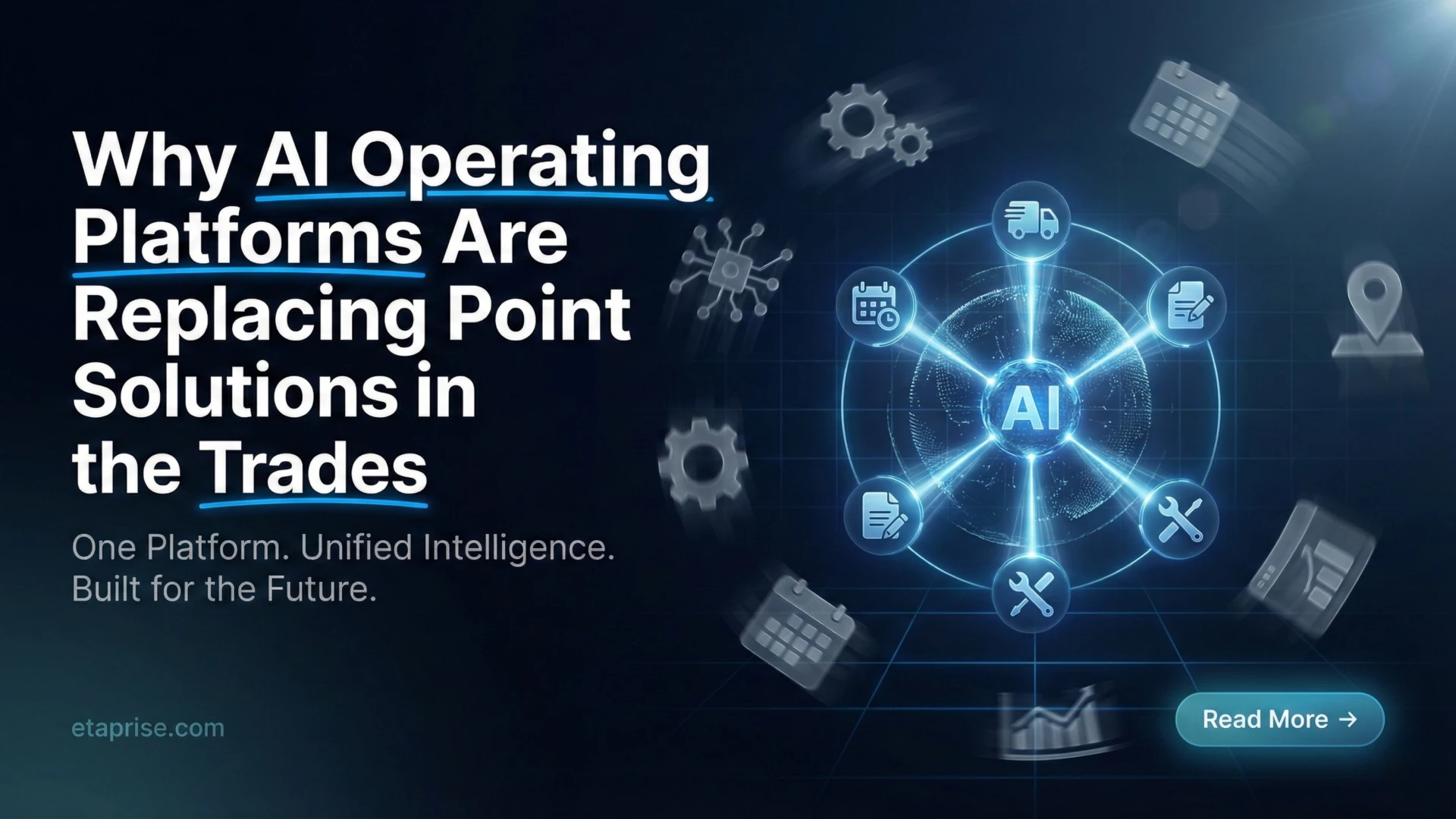
Modern enterprise field service and contracting organizations are choking on SaaS point-solution sprawl. Juggling separate tools for CRM, scheduling, mobile inventory, fleet telematics, and invoicing creates data silos, API synchronization latency, and crippling subscription overhead. Replacing fragmented software stacks with an autonomous, AI-native operating platform is the definitive architectural shift powering high-margin field service enterprises.
The Breakdown of the Multi-SaaS Point Solution Architecture
Over the past decade, field service enterprises adopted a ‘best-of-breed’ software philosophy. A commercial mechanical, electrical, or facilities contractor would subscribe to a standalone CRM (such as HubSpot or Salesforce), an independent field dispatch tool, a mobile inventory app, a separate GPS fleet tracking system, and a third-party accounting platform. To connect these disparate systems, IT teams constructed fragile integration webs using Zapier, webhooks, or custom REST APIs.
In practice, this fragmented architecture introduces severe operational failure modes. API rate limits and synchronization race conditions result in data discrepancies—a customer’s credit hold updated in accounting fails to sync with dispatch, allowing a technician to execute a $10,000 emergency repair on a delinquent account. Technicians must log into three distinct mobile apps on job sites, re-entering identical serial numbers and customer addresses. Meanwhile, corporate leadership lacks a single, unified source of truth to evaluate job profitability in real time.
The Architectural Superiority of a Unified AI Operating Platform
An enterprise AI operating platform replaces fragile point-solution integrations with a unified, transactional data model governed by native machine intelligence:
- Unified Relational Data Foundation: Customer relationship history, asset telematics, technician skills, inventory reserves, and financial ledgers exist in a single transactional schema with zero synchronization delay.
- Autonomous Multi-Variable Dispatch Engine: AI algorithms evaluate technician location, traffic patterns, tool certifications, parts inventory, customer SLA priority, and job profitability to schedule and dispatch work dynamically.
- Context-Aware Natural Language Field Agent: Technicians speak directly to their mobile assistant to query historical equipment wiring schematics, log parts consumed, and draft professional job summaries via voice-to-text.
- Predictive Cash Flow and Automated Billing: Completed work orders instantly reconcile labor hours, parts consumed, and contract rates, generating compliant digital invoices the second the customer signs off.
Field Architecture & Operational Reality
Enterprise Platform Mandate: Operating five disconnected SaaS tools costs an enterprise an average of $280 per technician per month in software licensing fees and administrative overhead. Consolidating into a unified AI operating platform eliminates integration failures while slashing total technology licensing costs by 45%.
Context-Aware AI: Beyond Superficial Chatbots
Most software vendors touting ‘AI features’ simply wrap generic LLM chatbots around basic documentation search bars. When a technician asks a generic bot how to troubleshoot an industrial boiler fault, the bot returns generic textbook descriptions that fail to account for the specific equipment model, installation history, or current sensor readings.
Etaprise operates on deep contextual intelligence. When a field technician on site queries the platform, the AI agent has full visibility into the equipment’s 5-year maintenance history, previous component serial numbers, live IoT pressure readings, and the customer’s active warranty terms. The platform delivers actionable, hyper-specific diagnostic guidance that empowers junior technicians to troubleshoot complex faults with the competence of a 20-year master mechanic.
Operational Benchmarks: Point-Solution Sprawl vs. Unified AI Platform
Transitioning from a fragmented multi-SaaS stack to an enterprise AI operating platform yields dramatic gains across administrative overhead, technician utilization, and billing speed.
| Operational Dimension | Fragmented Point-Solution Stack (5 Apps) | Etaprise Unified AI Operating Platform | Measurable Business Impact |
|---|---|---|---|
| Monthly SaaS Licensing Overhead | $21,000 monthly across 5 disconnected vendors | $11,500 monthly unified enterprise license | $114,000 Annual SaaS Saved |
| Administrative Data Double-Entry | 3.2 hours daily per office dispatcher | Zero double-entry via unified data architecture | 100% Elimination of Re-Keying |
| First-Time Fix Rate on Service Calls | 59% due to missing historical asset records | 88% with context-aware AI diagnostic support | +29% Resolution Accuracy |
| Work Order Invoicing Cycle Latency | 18 days average invoice generation time | Instant same-day automated invoice dispatch | 18 Days Accelerated Cash Flow |
The Future of Autonomous Field Operations
The future of field service management is autonomous. Rather than relying on human dispatchers to manually juggle dozens of incoming service calls and shuffle whiteboard schedules, an AI operating platform continuously self-optimizes. The platform detects incoming telemetry alarms, reserves parts, verifies technician credentials, and dispatches the optimal resource without requiring human intervention.
By automating the friction-laden operational mechanics of field service delivery, human managers are freed to focus on high-value client relationships, business development, and strategic workforce growth. Companies that lead this transition will dominate their regional markets, operating with higher gross margins, superior customer retention, and unrivaled operational agility.
Lead the Shift to Unified Field Operations with Etaprise
The era of duct-taping disconnected SaaS point solutions is over. Etaprise is the all-in-one AI operating platform built from the ground up to unify your entire field service enterprise—from initial customer quote to live asset telemetry, intelligent dispatch, and automated billing.
Ready to eliminate SaaS sprawl, empower your field technicians with context-aware AI, and accelerate enterprise cash flow? Connect with our enterprise platform architects today to explore a tailored demonstration.
Schedule an Enterprise AI Platform Consultation
Technical Deep Dive: Unified Transactional Schemas and Context-Aware LLMs
The fundamental failure of legacy field service architectures lies in data fragmentation across disconnected relational databases. When an enterprise maintains customer records in Salesforce, scheduling states in a dispatch tool, inventory counts in an ERP, and telematics in a separate cloud portal, building an autonomous operational workflow is architecturally impossible. Synchronization delays, schema mismatches, and API rate limits create an unbridgeable operational lag.
An enterprise AI operating platform solves this problem by building on a unified transactional database engine. Every customer interaction, telemetry reading, technician skill rating, parts inventory reserve, and billing ledger entry shares a normalized data schema with microsecond read-after-write consistency. Large Language Models (LLMs) and autonomous dispatch agents operate directly over this unified context window, analyzing live operational variables simultaneously without relying on brittle third-party integration pipelines.
Standard Operating Procedure: The Autonomous Service Ticket Lifecycle
Deploying an autonomous operating platform transforms customer service delivery into a frictionless, multi-step digital lifecycle:
- Step 1 — Automated Ingestion & Diagnostic Triage: Inbound telemetry alarms or customer service requests are parsed by natural language AI agents, identifying equipment models, failure symptoms, and contractual SLA windows.
- Step 2 — Autonomous Multi-Variable Resource Matching: The platform analyzes technician proximity, traffic congestion, required tool certifications, and truck stock inventory, dispatching the optimal technician in seconds.
- Step 3 — Context-Rich Field Execution Support: Upon arrival, the technician accesses interactive equipment diagnostic trees, historical service logs, and voice-assisted parts lookup directly on their mobile device.
- Step 4 — Automated Photographic & Digital Sign-Off: Technicians capture completed inspection photos and collect customer digital signatures, with the platform auto-compiling professional job close-out summaries.
- Step 5 — Instant Financial Reconciliation & Invoicing: Labor hours, consumed materials, and contractual rates are calculated instantly, pushing verified invoices to customer portals and syncing with corporate ERP ledgers.
Enterprise Implementation Playbook: 30-60-90 Day Rollout Plan
Consolidating disconnected SaaS tools into a unified AI operating platform follows a proven enterprise migration roadmap:
- Days 1–30: Legacy Data Migration & Schema Mapping: Ingest customer records, asset histories, price books, and inventory catalogs from legacy tools into the unified database; configure enterprise role-based security permissions.
- Days 31–60: Mobile Field Deployment & AI Dispatch Pilot: Equip field technicians with the mobile app, deploy voice-assisted standard work tools, and pilot automated dispatching across a 25-technician operating division.
- Days 61–90: Full Platform Consolidation & Legacy Tool Sunsetting: Transition all dispatching, inventory, and invoicing to the platform; sunset redundant SaaS subscriptions; and activate predictive revenue optimization analytics.
Enterprise Security & Compliance: SOC 2 Type II and Data Sovereignty
Consolidating enterprise operational data into a unified AI operating platform requires meeting the highest standards of enterprise cybersecurity, data encryption, and regulatory governance. Field service enterprises manage sensitive customer asset data, proprietary machinery telemetry, employee biometrics, and customer financial transactions that must be protected against malicious intrusion and ransomware threats.
Etaprise is engineered on a zero-trust enterprise security architecture certified under SOC 2 Type II, ISO 27001, and global privacy standards (GDPR, Australian Privacy Principles, HIPAA). All customer and telemetry data is secured using AES-256 encryption at rest and TLS 1.3 in transit, with role-based access controls (RBAC) and immutable audit trails that satisfy the security requirements of global Fortune 500 enterprises and defense contractors.
AI Operating Platform KPI Architecture: Enterprise Efficiency Metrics
Chief Operating Officers and enterprise technology executives evaluate unified AI platform returns across four strategic organizational benchmarks:
- Total Cost of Technology Ownership (TCO): The consolidated reduction in annual software licensing, third-party integration maintenance, and internal IT support expenditure.
- First-Time Fix Rate (FTFR) Across All Trades: The enterprise-wide percentage of field service requests resolved on the initial dispatch without secondary call-backs.
- Billing and Revenue Realization Velocity: The speed at which completed field work orders convert into collected cash, drastically compressing Days Sales Outstanding (DSO).
- Technician Utilization Percentage: The proportion of daily technician working hours spent actively executing billable field maintenance versus non-productive administrative overhead.
Worked Financial ROI: The Commercial Impact of SaaS Consolidation
Consolidating fragmented point solutions into a unified AI operating platform generates immediate cost reductions across software licensing, administrative payroll, and billing cycle acceleration. For a 75-technician contracting enterprise paying $280 per user monthly across five separate software vendors, annual software licensing exceeds $252,000.
Consolidating into Etaprise cuts annual software licensing to $138,000, saving $114,000 in direct software overhead. More significantly, eliminating 3.2 hours of daily dispatcher data re-keying saves $85,000 in administrative labor, while compressing the invoice-to-cash cycle from 18 days to same-day dispatch accelerates over $1,400,000 in enterprise operating liquidity, delivering an extraordinary first-year commercial ROI.
Enterprise Integration Architecture: Connecting with Core Corporate Backbones
Deploying an enterprise-grade field service operations platform requires seamless interoperability with core corporate IT systems, enterprise resource planning (ERP) backbones, and legacy data warehouses. Field operations cannot operate as an isolated software silo; technician labor hours, consumed inventory parts, asset maintenance histories, and completed job milestone verifications must synchronize with corporate general ledgers and procurement modules in real time.
Etaprise features an open, enterprise-grade API integration gateway supporting bi-directional RESTful and GraphQL interfaces, secure webhook event triggers, and pre-built certified connectors for leading corporate platforms—including SAP S/4HANA, Oracle NetSuite, Microsoft Dynamics 365, Salesforce, and Workday. Enterprise security is enforced through single sign-on (SSO) utilizing SAML 2.0 and OpenID Connect (OIDC) protocols across Okta, Microsoft Azure Active Directory, and Ping Identity, ensuring complete role-based governance and audit compliance across global operations.
Frequently Asked Questions
By maintaining all operational entities (customers, work orders, inventory, billing ledgers) in a single transactional database, state changes are instantaneous and atomic, eliminating webhook delays, API rate limit throttles, and data mismatches.
Yes. Field technicians can use natural language voice prompts to log parts used, search asset repair histories, dictate detailed customer summaries, and complete checklists hands-free while wearing work gloves on job sites.
When an emergency work order arrives, the dispatch engine evaluates all active technicians, identifying the candidate whose re-routing minimizes total fleet travel variance and avoids breaching existing customer SLAs, dynamically updating routes in seconds.
Etaprise provides automated migration pipelines that ingest customer lists, asset histories, price books, and open work orders from legacy platforms within days, typically achieving full enterprise cutover within two to four weeks.
Yes. While replacing front-line operational point solutions, Etaprise features enterprise-grade connectors for corporate accounting and ERP systems like SAP S/4HANA, NetSuite, and Microsoft Dynamics 365 for consolidated financial reporting.