

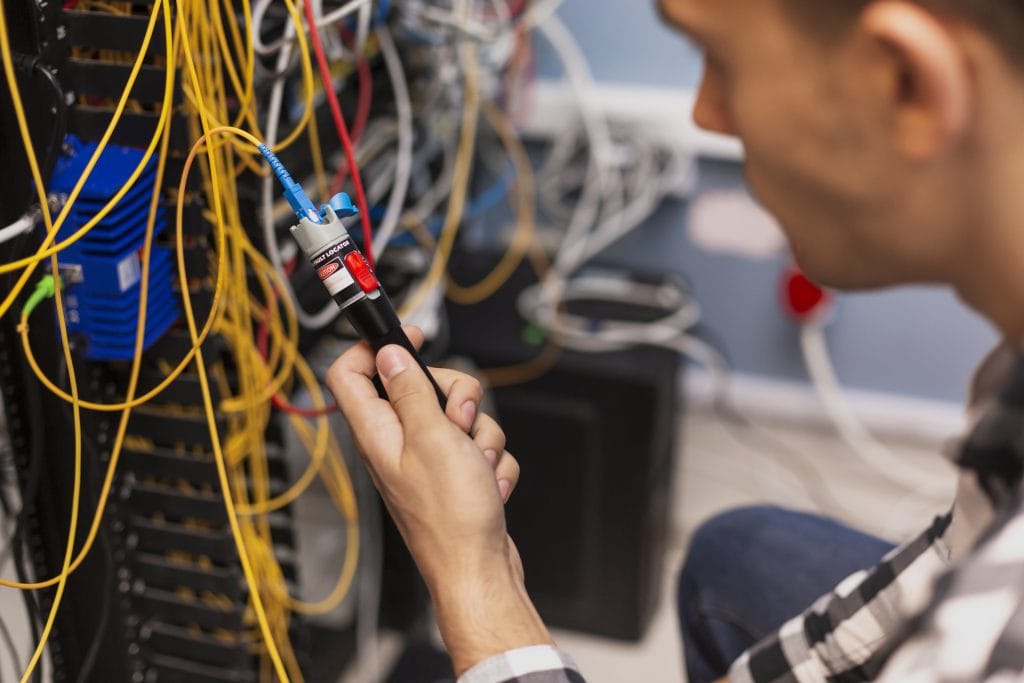
In telecommunications infrastructure deployment and service delivery, field technician productivity is the single greatest determinant of operational margin. Telecommunications service providers can supercharge field technician output by deploying automated test instrument synchronization, dynamic multi-stop route optimization, mobile digital van stocking, instant carrier close-out compilation, and automated SLA penalty defense.
The Hidden Productivity Leaks in Telecommunications Field Service
Telecommunications field technicians spend an alarming percentage of their working day engaged in non-productive administrative and logistical tasks. Industry studies reveal that an average telecom technician spends less than 45% of their working hours actively installing equipment, splicing fiber, or resolving network faults. The majority of their shift is consumed by driving inefficient routes, waiting for dispatch updates, searching for missing parts, manually transcribing sweep test numbers into paper forms, and sorting through hundreds of site photos.
In high-pressure service environments governed by strict Service Level Agreements (SLAs) with carrier clients, these operational delays result in severe contractual financial penalties. Furthermore, uncoordinated dispatches lead to excessive overtime expenditure and technician burnout. Elevating field productivity requires systematically eliminating administrative friction and empowering technicians with automated mobile tools.
5 Core Capabilities That Transform Telecom Field Output
Deploying an enterprise-grade field service management platform unlocks five direct productivity multipliers across daily technician operations:
- 1. Direct Bluetooth Test Instrument Integration: Optical time domain reflectometers (OTDR), Ethernet bit error rate testers (BERT), and RF sweep analyzers transmit pass/fail traces directly to mobile work orders via Bluetooth, eliminating manual data entry.
- 2. Dynamic Multi-Stop Routing and Traffic Intelligence: Intelligent dispatching algorithms sequence daily service tickets based on technician location, real-time traffic congestion, and SLA deadlines, cutting windshield travel time by over 35%.
- 3. Mobile Barcode Van Stocking and Automated Staging: Technicians scan serialized transceivers, fiber splitters, and drop cables directly off their vehicle inventory, triggering automated nightly re-order requisitions.
- 4. Instant Geotagged Photo and COP Generation: In-app camera tools enforce mandatory carrier photo angles with embedded GPS timestamps and compass bearings, auto-compiling carrier close-out packages with zero manual collation.
- 5. Automated SLA Countdown and Penalty Shields: Work orders display live countdown timers linked to contractual SLA breach thresholds, dynamically re-routing nearby technicians to prevent high-cost liquidated damages.
Field Architecture & Operational Reality
Productivity Multiplier: Automating test file extraction from OTDR and RF spectrum analyzers saves 22 minutes per service call. Multiplied across an 80-technician field workforce, this recovers over 3,500 billable field hours every month.
Eliminating Carrier Penalty Fines with Real-Time SLA Defense
Tier-1 carrier contracts typically mandate strict Mean Time to Restore (MTTR) performance windows for business-critical cell sites and enterprise fiber circuits—often demanding resolution within two to four hours. Contractual penalties for missing these SLA windows can exceed $1,500 per hour of delay.
Etaprise functions as an active SLA defense shield. Dispatchers view real-time countdown clocks color-coded by urgency across all active network outages. If a technician encounters unforeseen access delays at a locked commercial rooftop, the system automatically logs contemporaneous timestamps and alerts dispatch to escalate site access, preventing disputed carrier penalties.
Operational and Financial Benchmarks: Telecom Productivity Gains
The financial leverage achieved by equipping telecom technicians with an integrated mobile field platform is demonstrated across completed job volumes, travel time reduction, and penalty avoidance.
| Performance Dimension | Legacy Manual Operations | Etaprise Telecom Productivity Platform | Measurable Operational Impact |
|---|---|---|---|
| Daily Completed Work Orders per Tech | 3.1 completed trouble tickets/installations | 5.2 completed tasks with optimized routing | +67% Daily Job Volume |
| Daily Windshield Travel Time | 2.8 hours per technician spent in transit | 1.6 hours via dynamic route optimization | 42% Travel Time Saved |
| Carrier SLA Breach Penalties | $320,000 paid annually in liquidated damages | $18,000 with real-time countdown alerts | $302,000 Penalty Reduction |
| Van Stockout Unscheduled Return Trips | 18.4% of dispatches require depot parts run | 2.1% through barcode automated replenishment | 88% Fewer Parts Delays |
Standardizing Quality Across In-House Technicians and Subcontractors
Telecom infrastructure providers frequently scale their capacity by augmenting full-time employees with third-party contractor crews during major rollouts. However, subcontractor work quality is notoriously variable, often leading to unverified fiber splices, loose coaxial connectors, or missing weatherproofing tape that causes latent water ingress during winter storms.
Etaprise enforces identical, rigorous digital inspection workflows across both internal technicians and third-party subcontractors. Work orders require mandatory step-by-step photographic sign-offs, torque wrench confirmations, and certified instrument test uploads before contractor invoices can be approved, guaranteeing uniform network build quality across your entire ecosystem.
Supercharge Your Telecom Field Fleet with Etaprise
In the highly competitive telecommunications sector, technician productivity is the engine of profitability. Etaprise equips field technicians with the automated test ingestion, dynamic routing, and instant close-out tools needed to execute more jobs per day with zero compromise on quality.
Discover how your telecommunications enterprise can boost technician output by over 60% and eliminate SLA penalty exposure. Connect with our telecommunications productivity specialists today.
Request a Telecom Fleet Productivity Demo
Technical Deep Dive: Optical Characterization and 5G Beamforming Alignment
Deploying high-capacity 5G small cells and multi-hundred-core optical fiber distribution networks requires sub-millimeter physical precision and exacting RF radiofrequency engineering. In massive MIMO (Multiple Input Multiple Output) 5G antenna installations, beamforming performance depends on precise physical antenna mechanical tilt, azimuth alignment, and roll parameters. A physical alignment deviation of just 2 degrees can degrade cellular coverage across an entire metropolitan traffic corridor.
The enterprise telecom field architecture connects directly to precision field test equipment via low-latency Bluetooth interfaces. When technicians align 5G panel antennas, real-time azimuth sensors stream orientation angles into the mobile app, validating mechanical coordinates against carrier design specifications. For optical fiber splicing, the platform interfaces with optical time-domain reflectometers (OTDR) and digital inspection probes, evaluating optical insertion loss and back-reflection against ITU-T G.652 standards and validating network integrity before site commissioning.
Standard Operating Procedure: The 5-Stage Tower Maintenance Protocol
Ensuring climber safety and carrier compliance during cell tower maintenance demands an immutable five-stage operational workflow:
- Step 1 — Pre-Climb Job Safety Analysis (JSA) & Rigging Inspection: The tower crew verifies rope inspection logs, capstan hoist certifications, and personal fall-arrest lanyards before establishing the drop zone perimeter.
- Step 2 — Carrier RF Lockout & Sector Power Reduction: Technicians coordinate with the mobile network operations center (NOC), verifying that active transmitter power on adjacent antennas is reduced below FCC safe limits.
- Step 3 — Elevated Structural & Antenna Line Inspection: Rigging hands ascend the mast, inspecting guy wire tension, coaxial weatherproofing seals, and structural bolt torque specifications.
- Step 4 — Automated Test Trace Capture: Technicians connect portable analyzers to antenna lines, executing return loss sweeps, PIM testing, and fiber OTDR traces, auto-syncing test files to the work order.
- Step 5 — Carrier Close-Out Compilation & NOC Re-Commissioning: The crew uploads geotagged photo angles, the NOC restores full sector power, and the mobile platform auto-generates the certified Close-Out Package.
Enterprise Implementation Playbook: 30-60-90 Day Rollout Plan
Scaling a telecommunications field operations platform across wireless tower hands, wireline fiber splicers, and third-party contractors requires a structured rollout:
- Days 1–30: Test Tool Integration & COP Template Design: Configure Bluetooth drivers for VIAVI, EXFO, and Anritsu test sets, design carrier-specific Close-Out Package templates, and set up climber credential profiles.
- Days 31–60: Van Stocking & Contractor Portal Deployment: Implement mobile barcode van inventory replenishment, onboard third-party rigging contractors through the external portal, and train dispatchers on dynamic routing.
- Days 61–90: Full Fleet Scale & Automated SLA Penalty Protection: Deploy the platform across the entire regional workforce, activate live SLA countdown timers, and integrate completed job records with enterprise accounting for same-day invoicing.
Regulatory Defense: FCC RF Radiation Limits and Carrier Close-Out Integrity
Telecommunications operators and infrastructure contractors face aggressive regulatory oversight regarding radiofrequency (RF) radiation exposure, tower climbing safety, and municipal right-of-way permitting. Violations of FCC or ACMA maximum permissible exposure (MPE) limits or operating unlicensed microwave link frequencies result in severe commercial license suspensions and substantial monetary fines.
Furthermore, commercial relationships with Tier-1 carriers depend entirely on the evidentiary integrity of Close-Out Packages (COPs). Etaprise secures contractor operations by enforcing calibrated RF monitor verification before rooftop small cell access unlocks, alongside automated extraction of Bellcore/Telcordia .SOR optical fiber traces. By proving that work complied with carrier engineering standards and federal safety rules, contractors protect their business reputation and secure rapid milestone payments.
Telecom Field Fleet KPI Architecture: Output and SLA Governance
Telecom field operations directors and contracting executives measure workforce output across four primary operational indicators:
- Daily Completed Work Orders per Technician: Measuring daily task throughput across fiber splicing, antenna alignment, and cell site trouble tickets.
- Carrier SLA Compliance Rate: The percentage of high-priority emergency restoration dispatches completed within contractual 2-to-4 hour MTTR windows, eliminating liquidated damages.
- First-Time Optical Splice Pass Rate: The percentage of optical fusion splices meeting strict carrier dB loss budgets on initial OTDR testing without requiring costly re-burns.
- Close-Out Package First-Pass Acceptance: The percentage of carrier close-out dossiers accepted without rejections for missing photographic evidence or unverified sweep tests.
Worked Financial ROI: Technician Labor Recovery and SLA Penalty Shielding
In telecommunications field service contracting, operational gross margin is determined by billable task throughput and contractual SLA penalty avoidance. On a 100-technician field workforce, technicians transcribing manual sweep tests and driving un-optimized routes complete an average of 3.1 trouble tickets per day at a labor cost of $82 per hour.
Automating OTDR test ingestion and optimizing multi-stop dispatch boosts daily completion from 3.1 to 5.2 work orders per technician. This 67% capacity expansion unlocks an additional $3,200,000 in annual installation revenue without expanding fleet headcount. Combined with eliminating $302,000 in carrier SLA late penalties, the enterprise achieves full platform payback within 75 days of deployment.
Enterprise Integration Architecture: Connecting with Core Corporate Backbones
Deploying an enterprise-grade field service operations platform requires seamless interoperability with core corporate IT systems, enterprise resource planning (ERP) backbones, and legacy data warehouses. Field operations cannot operate as an isolated software silo; technician labor hours, consumed inventory parts, asset maintenance histories, and completed job milestone verifications must synchronize with corporate general ledgers and procurement modules in real time.
Etaprise features an open, enterprise-grade API integration gateway supporting bi-directional RESTful and GraphQL interfaces, secure webhook event triggers, and pre-built certified connectors for leading corporate platforms—including SAP S/4HANA, Oracle NetSuite, Microsoft Dynamics 365, Salesforce, and Workday. Enterprise security is enforced through single sign-on (SSO) utilizing SAML 2.0 and OpenID Connect (OIDC) protocols across Okta, Microsoft Azure Active Directory, and Ping Identity, ensuring complete role-based governance and audit compliance across global operations.
Frequently Asked Questions
Instead of manually typing measured optical dB losses or RF return loss numbers from test screens into paper reports, the mobile app pulls test files directly over Bluetooth, validates results against threshold standards, and attaches them to the work order instantly.
Yes. If a technician logs a customer no-show with timestamped photo proof, the dispatch engine instantly re-sequences their day, assigning a nearby network maintenance or fiber drop task to eliminate idle downtime.
Technicians scan parts barcodes as they install them on jobs. The system monitors truck inventory levels against minimum par thresholds, automatically generating replenishment pick-lists for overnight warehouse restocking.
The mobile application includes pre-configured COP photo checklists for major carriers. Photos taken in-app automatically stamp GPS coordinates, compass headings, and date/time watermarks, formatting the final PDF dossier instantly upon work order sign-off.
Key indicators include jobs completed per technician per day, wrench time versus windshield time, first-time resolution rate, carrier close-out acceptance rate, and SLA compliance percentage across all assigned territories.